Steam Controller 2: Why Valve’s New Hardware Leads
Valve confirms May 4 launch for Steam Controller 2 at $99, featuring TMR sensors and a magnetic charging puck.
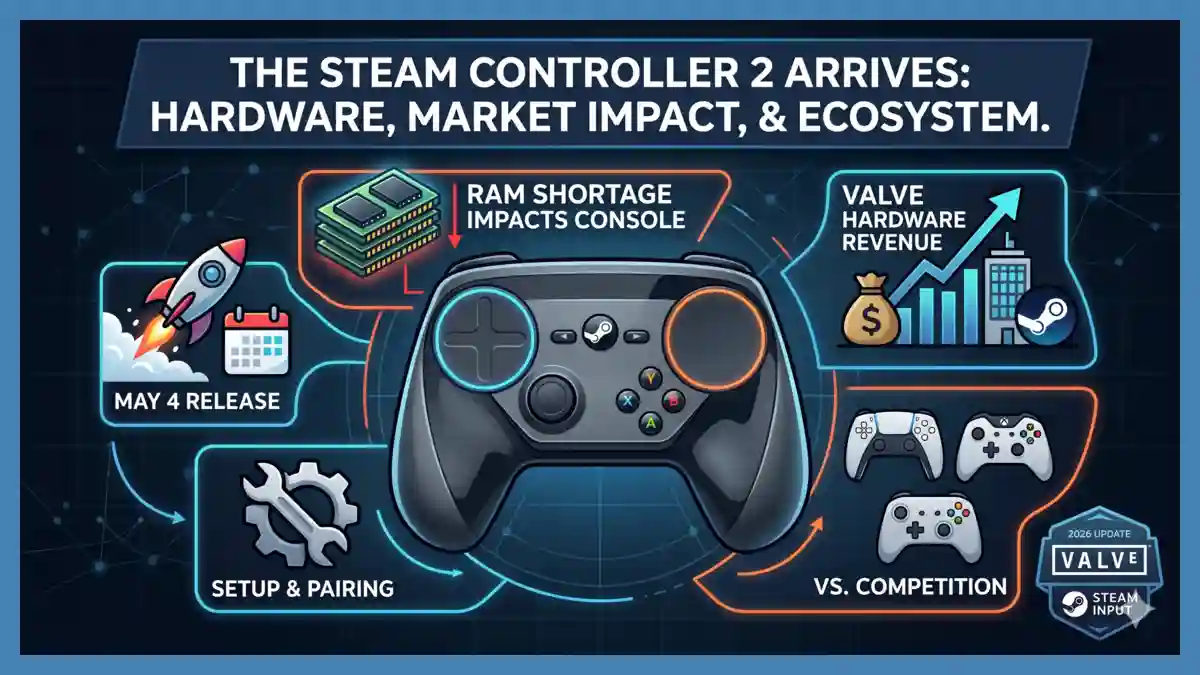
Valve has officially confirmed the Steam Controller 2 will launch on May 4, 2026, marking the company’s first return to dedicated gamepads since the original was discontinued in 2019. This new hardware serves as a high-performance extension for the Steam Deck and the upcoming Steam Machine, introducing Tunneling Magnetoresistance (TMR) thumbsticks that offer higher precision than standard Hall Effect sensors. The launch is part of a broader Valve hardware launch event strategy that positions the controller as a Valve storefront exclusive at a retail price of $99.
For PC and handheld gamers, the Steam Controller 2 release addresses several long-standing requests, including integrated haptics, dual trackpads, and a unique “Plug and Play Puck” that acts as both a wireless transmitter and a magnetic charging station. With a Steam Controller 2 pre-order window expected to open shortly on the official release window timeline, the device enters a competitive market. Buyers are currently weighing it against Steam Deck controller alternatives such as the 8BitDo Ultimate series, the GameSir Tarantula Pro, the rumored Xbox Elite Series 3, and the aging Switch Pro controller. This new Steam hardware 2026 announcement suggests Valve is doubling down on its ecosystem, prioritizing deep integration over broad console compatibility.
Technical Specifications and Design Overview
The Steam Controller 2 features a design that mirrors the input layout of the Steam Deck, ensuring a seamless transition for handheld users moving to a docked or desktop environment. Unlike the 2015 original, which relied heavily on trackpads to simulate mouse input, the 2026 model adopts a more traditional “full-sized” control scheme while retaining the signature dual haptic trackpads.
A standout feature is the shift to TMR (Tunneling Magnetoresistance) technology for the thumbsticks. While Hall Effect sensors have become the industry standard for preventing “stick drift,” TMR sensors offer lower power consumption and higher resolution tracking. This hardware choice is aimed at competitive players who require extreme accuracy in fast-paced titles.
Key Specifications: Steam Controller 2
| Feature | Specification |
| Sensors | TMR (Tunneling Magnetoresistance) Anti-Drift Sticks |
| Inputs | Dual Trackpads, 4 Grip Buttons, 6-Axis Gyro |
| Battery Life | 35+ Hours |
| Connectivity | 2.4GHz (Puck), Bluetooth, USB-C |
| Charging | Magnetic Puck Station / Wired USB-C |
| Price | $99 USD / €99 / £85 |
Pricing and Availability Analysis
The Steam Controller 2 price of $99 places it in the “pro-grade” category, sitting significantly above standard first-party controllers like the Xbox Wireless Controller ($60) or the Switch Pro ($70). However, it remains more affordable than the $179 Xbox Elite Series 2 or the anticipated Xbox Elite Series 3.
Steam Controller 2 availability will initially be limited to the Steam Store and official distributors in specific regions. At launch, the device will be available in the U.S., Canada, UK, EU, and Australia. In Asian markets, including Japan, South Korea, Hong Kong, and Taiwan, distribution will be handled through authorized partners such as Komodo.
Analysis: The Value of the Charging Puck
The inclusion of the “Plug and Play Puck” is a significant factor in the $99 price point. Most competitive controllers require a separate purchase for a charging dock or a high-speed wireless dongle. Valve’s decision to bundle a magnetic charging base that doubles as the wireless receiver adds roughly $20–$30 in perceived value, making the $99 MSRP more competitive against third-party brands like 8BitDo.
Steam Controller 2 vs. Leading Alternatives
When evaluating new Steam hardware 2026, consumers must consider how Valve’s offering stacks up against established third-party and first-party rivals. While the Steam Controller 2 offers the best integration for SteamOS, other brands provide cross-platform flexibility that Valve’s hardware lacks.
GameSir Tarantula Pro: This alternative utilizes “Mag-Res” TMR sticks similar to Valve’s and retails for approximately $70–$80. It features 9 mappable buttons and full support for Switch and Android, which the Steam Controller does not officially prioritize.
8BitDo Ultimate 2: Known for its Hall Effect sensors and charging dock, the 8BitDo remains a budget-friendly favorite at $60. It lacks the dual trackpads essential for certain PC-centric genres like RTS or 4X strategy games.
Xbox Elite Series 3: While not yet fully detailed, leaks suggest this controller will focus on cloud gaming connectivity. It is expected to remain in the $150+ price bracket, targeting the ultra-premium segment.
Real-World Usability and Steam Integration
The primary draw of the Steam Controller 2 is its “Grip Sense” technology and native Steam Input support. Because the button layout is identical to the Steam Deck, community-made control schemes will work across both devices without remapping. The grip-enabled gyro allows for “aiming by tilting,” a feature that has gained a dedicated following among handheld gamers.
Durability is another focus for this release. By using TMR sensors, Valve is addressing the most common failure point in modern controllers: the potentiometer-based thumbstick. These sensors do not rely on physical contact to measure movement, theoretically extending the lifespan of the controller to several years of heavy use.
Market Trends: Why Now?
The timing of the Valve announcement and the subsequent May 4 release coincides with a broader industry shift toward specialized PC gaming peripherals. As the Steam Deck continues to dominate the handheld market, a gap has formed for a “living room” controller that doesn’t sacrifice the unique inputs (trackpads and back buttons) that Deck users have grown accustomed to.
Furthermore, the Valve storefront exclusive nature of the launch allows Valve to bypass traditional retail markups and maintain a direct relationship with its core audience. This strategy mimics the successful rollout of the Valve Index and the Steam Deck, prioritizing supply for active Steam users before expanding to wider retail channels.
Buyer Considerations
Before choosing to buy Steam Controller 2, shoppers should evaluate their primary gaming platform. This is a specialized tool designed specifically for the Steam ecosystem.
Pros: Precision TMR sticks, identical layout to Steam Deck, included charging/receiver puck, and unmatched software customization.
Cons: Higher price point than standard controllers, lack of native support for Xbox or PlayStation consoles, and limited availability outside the Steam Store.
For users who spend the majority of their time in Steam’s Big Picture mode or who frequently dock their Steam Deck, the $99 investment offers a level of hardware-software synergy that third-party controllers cannot currently match.
Stay sharp with Ongoing Now!
Source and Data Limitations: Data for this guide is sourced from official Valve hardware listings, manufacturer specifications from GameSir and 8BitDo, and retail pricing confirmed as of April 2026. Regional pricing for the Steam Controller 2 (CAD, EUR, GBP, AUD) is based on official Valve distribution notes. Technical details regarding TMR (Tunneling Magnetoresistance) are verified against current sensor industry standards. Information regarding the Xbox Elite Series 3 and Nintendo Switch Pro remains based on verified industry reporting from February 2026; final retail specs for these unreleased models may vary. Availability is subject to regional shipping constraints and Valve’s rolling release schedule.