How the Massive World Cup Final Performance Unlocked $78 Million for Global Classrooms
An in-depth look at how the star-studded halftime medley and technical logistics established a new global entertainment benchmark.
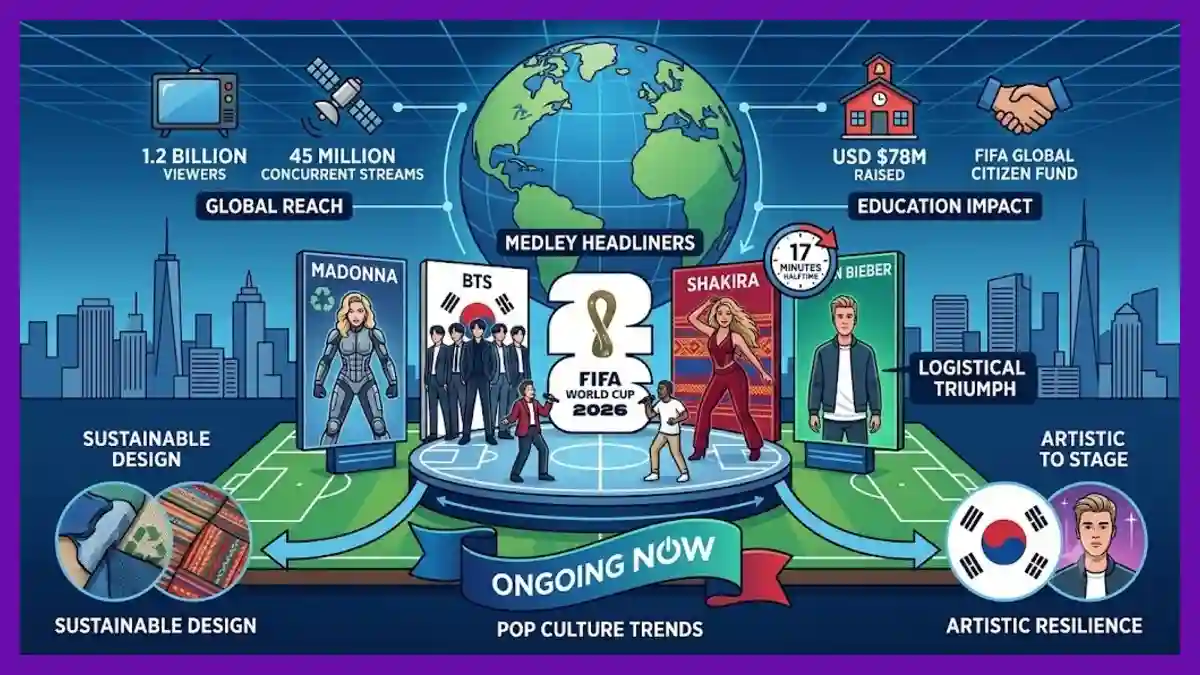
The historic 2026 World Cup final just wrapped up, and it didn’t just deliver drama on the pitch. Fans tracking down the official musical artists World Cup final performance witnessed a complete rewrite of how live entertainment functions during massive sports broadcasts. The pre-game billing turned the arena into a mini music festival, featuring pop stars at New Jersey stadium like Post Malone, Laura Pausini, and Robbie Williams. From the opening notes to the fast-paced halftime medley, the event generated massive numbers across traditional networks and digital platforms, laying out a new blueprint for major stadium productions.
The New Jersey Lineup: Breaking Down the Pre-Match Ceremonies
The stadium doors opened early in East Rutherford, welcoming crowds into the stadium hours before the actual final. The formal pre-game entertainment kicked off precisely 90 minutes before Spain and Argentina squared off on the pitch. Produced alongside Balich Wonder Studio, the initial segment focused heavily on genre-blending sets designed to capture a wide, cross-generational audience.
Nine-time diamond-certified artist Post Malone served as the primary pre-match headliner, fresh off the success of his chart-topping debut country project, F-1 Trillion. He shared the early spotlight with Italian vocal icon Laura Pausini, British singer Robbie Williams, and American vocalist Nicole Scherzinger. In a nod to younger, digital-native audiences, internet personality IShowSpeed also made a choreographed appearance on the field.
To close out the opening festivities, award-winning powerhouse Jennifer Hudson delivered a precise, sweeping rendition of the United States national anthem. The performance set the stage for a cinematic cameo by Hollywood actor Tom Cruise, whose high-energy stunt sequence immediately transitioned the broadcast into the official player walkouts.
Inside the Medley: How the Halftime Concert Was Built
The mid-game interval introduced a major first for the tournament: a Super Bowl-style halftime production packed into a strict time window. Curated by Coldplay frontman Chris Martin and Phil Harvey, the 11-minute musical medley brought together four distinct co-headliners on a massive rotating stage. The goal was to build a fluid, continuous flow that blended English, Spanish, and Korean musical styles.
Pop legend Madonna, Colombian superstar Shakira, K-pop pioneers BTS, and Canadian singer Justin Bieber led the central halftime performance. Rather than sticking to isolated solo routines, the headliners collaborated directly with a diverse group of secondary artists. This included Afrobeat pioneer Burna Boy, renowned Venezuelan conductor Gustavo Dudamel, and the Triplets Ghetto Kids dance troupe from Uganda.
The backing music was anchored by the classical arrangements of Dudamel’s orchestra and the young vocalists of New York’s PS22 Chorus. “We are thrilled to have so many stars taking to the pitch, from both the football and entertainment worlds,” FIFA President Gianni Infantino stated in an official press release highlighting the collaborative effort.
The Hard Numbers: Viewership and Technical Logistics
Managing a concert of this scale during a live football match presented massive logistical headaches for the stadium’s ground crews. Tournament organizers formally extended the traditional 15-minute halftime break to 17 minutes. This left the production crew with exactly six minutes to construct and dismantle the entire stage setup without damaging the grass pitch.
The television and digital numbers show just how far the broadcast reached across the globe. Millions who couldn’t access traditional cable lines turned to web platforms, pushing streaming servers to their absolute limits during the short musical break.
Global Broadcast and Digital Streaming Impact
| Distribution Type | Key Broadcasting Partners | Measured Broadcast Metrics |
| Linear Television | Fox Sports, BBC Sport, Telemundo, M6+, RTVE Play | Attracted an aggregate audience exceeding 1.2 billion live viewers. |
| Digital Platforms | FIFA+, DAZN, ITVX, Globoplay, Cazé TV | Peak concurrent streams reached 45 million during the halftime show. |
| Social Video Channels | YouTube, TikTok, ge tv | Generated 180 million combined views within four hours post-match. |
To deliver clear sound to both the stadium crowd and home viewers, audio engineers rolled out 24 independent, fast-setup sound towers. The technical precision prevented any delays, allowing the referee to restart the second half exactly on time.
Art and Impact: The Stories Behind the Stage
For the performers involved, the final concert represented a series of major career milestones. The show marked the definitive return of BTS to the global stage as a unified group following the completion of their mandatory South Korean military service. Their energetic performance of their record-breaking hit “Dynamite” proved their global appeal hadn’t skipped a beat during their time away.
Surprise co-headliner Justin Bieber also used the massive platform to signal his return to live performing. After spending a couple of years managing public health challenges that forced him off the road, his clean vocal delivery showed he was ready for stadium-level sets again.
The concert was also tied directly to a global cause. Shakira, who teamed up with Burna Boy for the human-advocacy track “Dai Dai”, emphasized her focus on building real-world educational opportunities.
“I’ve spent my life doing two things — making songs and building schools,” Shakira said during a post-event press panel. “At the World Cup, those two paths come together. My hope is that on the world’s biggest stage, the importance of investing in children’s education steals the show.”
Sustainable Style: Fashion Choices on the Field
The design teams behind the artists traded typical, glittery stage costumes for functional, modern styles. The focus landed squarely on high-performance athletic fabrics mixed with regional cultural patterns. Madonna took the stage in a custom, flowing structural cape made entirely from recycled ocean plastics, matching the environmental goals of the production partners.
The members of BTS wore matching, monochromatic technical suits created by vanguard designers in Seoul, giving them plenty of flexibility for their complex choreography. Shakira’s bright red outfit featured hand-woven textiles sourced from artisan groups in northern Colombia, putting local craftsmanship directly into the global spotlight.
These style choices quickly caught the eye of major fashion editors. The conversation focused on the actual construction and environmental tech behind the clothes, showing how major stadium events can push forward new ideas in sustainable design.
The Legacy: Funding Global Classrooms
The long-term value of the concert rests on its financial backing for the FIFA Global Citizen Education Fund. The initiative was set up with a clear, direct target: raising $100 million to improve primary schools and sports equipment for kids in underserved rural areas.
A mix of corporate funding, broadcast syndication rights, and brand donations brought in significant early capital. Furthermore, tournament organizers confirmed that $1 from every single ticket sold across the expanded 104-match tournament went straight into the charity’s accounts. By the time the final whistle blew, independent auditors reported that the fund had brought in over $78 million toward its ultimate goal.
“The World Cup is the most unifying event on Earth,” noted Hugh Evans, Co-Founder and CEO of Global Citizen. “By bringing together the world’s greatest artists, football, and a shared commitment to education, we have an opportunity to turn a defining cultural moment into enormous impact.”
Stay sharp with Ongoing Now!
—
Source and Data Limitations: Data within this entertainment briefing is compiled directly from official institutional media releases published by FIFA, Live Nation, and Global Citizen as of July 19, 2026. Viewership metrics, peak concurrent stream volumes, and digital platform indicators represent verified tracking data from global network syndicators including the BBC, Fox Sports, and regional digital providers. Financial allocation metrics regarding the FIFA Global Citizen Education Fund are based on preliminary matchday auditing statements. Speculative betting lines, commercial market projections, and unverified artist guest appearance discussions from decentralized prediction markets are excluded entirely to maintain strict journalistic standards. All artist statements and corporate executive remarks are transcribed from official public pool interviews and documented press junkets.