Nancy Guthrie Missing Case: Digital Forensics & Physical Evidence
The primary criminal investigation into the disappearance of Nancy Guthrie entered its second week as federal and local authorities analyzed technical data points from the 84-year-old’s Tucson residence.

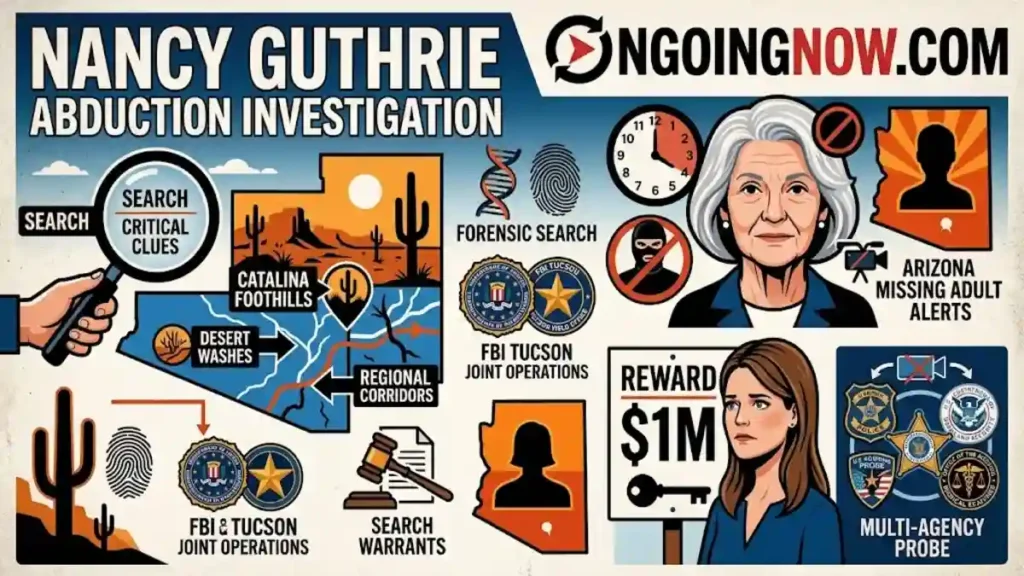
The disappearance of Nancy Guthrie from her home in the Catalina Foothills on February 1, 2026, has transitioned from a missing person search to a complex criminal investigation involving the FBI and the Pima County Sheriff’s Department. Law enforcement officials have confirmed the discovery of bloodstains at the residence and are currently evaluating a series of unorthodox Nancy Guthrie ransom demand messages sent via cryptocurrency channels. Beyond the physical search, the case has highlighted significant vulnerabilities in consumer technology, as investigators reconstruct a technical timeline of Guthrie kidnapping using disconnected smart home devices and medical monitoring data.
Technical Timeline of the Catalina Foothills Incident
Investigators have established a precise window for the alleged abduction by synthesizing data from the victim’s digital footprint. Nancy Guthrie was last seen at approximately 9:50 p.m. on January 31, 2026, when she was dropped off at her home by her son-in-law, Tommaso Cioni, following a family dinner.
The security infrastructure at the residence provided the first indicators of a breach. According to the Pima County Sheriff’s Department, the home’s doorbell camera was manually disconnected at 1:47 a.m. on February 1. Digital forensics later revealed a motion detection trigger at 2:12 a.m. on a secondary security camera; however, no footage was archived due to a lapsed service subscription.
The most critical data point in the technical timeline of Guthrie kidnapping occurred at 2:28 a.m., when the pacemaker app tracking data on Nancy Guthrie’s smartphone registered a terminal disconnection. This suggests the victim was moved beyond the Bluetooth range of her mobile device, which remained inside the home.
Key Forensic Milestones
| Time (Feb 1, 2026) | Event Type | Forensic Source |
| 01:47 AM | Device Tampering | Nest Doorbell Camera Disconnection |
| 02:12 AM | Motion Detection | Smart Home Security Hub |
| 02:28 AM | Biometric Signal Loss | Forensic analysis of pacemaker signals |
| 11:00 AM | Scene Discovery | Family Welfare Check |
Forensic Analysis of Physical and Digital Evidence
The investigation has utilized forensic analysis of pacemaker signals and residual smart home security breaches to narrow the search radius. Pima County Sheriff Chris Nanos confirmed that bloodstains found near the entrance of the home were DNA-matched to Nancy Guthrie, establishing the residence as a violent crime scene.
Federal investigators are specifically looking into Nest camera tampering techniques used during the incident. Surveillance images released by FBI Director Kash Patel on February 10 show an armed, masked individual on the porch attempting to obscure the camera lens with a glove and nearby foliage. These images were recovered through “residual data” located in backend systems, as the live recording had failed to save.
“The methodology of these individuals doesn’t match what typical kidnappers do who are holding someone for ransom,” stated Andrew Black, former FBI special agent. “They usually establish a direct line of communication with the family and law enforcement and they exclude the public and the media.”
The Role of Ransom Demands and Cryptocurrency
The FBI Nancy Guthrie investigation is currently vetting multiple ransom communications. One high-profile demand, requesting $6 million in Bitcoin, was sent not only to the family but also to various news outlets and a media organization in Tucson.
Authorities remain cautious regarding the authenticity of these demands. FBI Special Agent in Charge Heith Janke noted that at least one individual has already been arrested for an “imposter ransom demand” unrelated to the actual abduction. The lack of traditional “proof of life” signals—such as a current photograph or specific personal information—has led some experts to question if the primary captors are the ones communicating.
The Nancy Guthrie ransom demand also included specific deadlines that passed on February 5 and February 9 without further verified contact. Investigators are using AI-assisted linguistics tools to determine if the notes were generated by human authors or automated scripts.
Secure Smart Home and Medical Device Management
The Guthrie case has prompted a broader discussion on how to secure doorbell cameras and the risks associated with health device geolocation. Nancy Guthrie’s reliance on a pacemaker provided a digital breadcrumb that would not exist in many other missing persons cases. However, the disconnection of her pacemaker app tracking data also highlights the limitations of these systems when separated from their host smartphones.
For the general public, the Nancy Guthrie digital footprint serves as a case study in home security maintenance. Experts suggest that while smart devices provide convenience, they are susceptible to:
Physical Obfuscation: Masking lenses or disconnecting power sources.
Signal Jamming: Using frequency jammers to prevent Wi-Fi-based cameras from uploading footage.
Subscription Gaps: Failing to maintain cloud storage, which can result in the loss of critical evidence during an incident.
Public Statements and Community Impact
Savannah Guthrie and her siblings, Annie and Camron, have issued multiple public pleas for their mother’s safe return. In a video released on February 9, Savannah Guthrie addressed the suspected abductors directly, stating, “We received your message and we understand. We beg you now to return our mother to us.”
The Savannah Guthrie family statement emphasized Nancy Guthrie’s physical vulnerability, noting that the 84-year-old is unable to walk 50 yards unassisted and requires daily heart medication. The Tucson police Nancy Guthrie teams have extended their search to include local infrastructure, such as drainage systems and septic tanks near the Catalina Foothills, though no significant breakthroughs have been reported.
Analysis: The Intersection of Aging and Technology in Crime
The Arizona kidnapping Feb 2026 represents a shifting trend in criminal investigations where health device geolocation and Nancy Guthrie digital footprint analysis become as vital as traditional DNA evidence. In this instance, the “digital witness”—the pacemaker—provided a more accurate time of departure than any human observer could.
Why This Case Matters for Public Safety
Vulnerability of the Elderly: The targeting of a mobility-impaired individual in a high-security area suggests pre-meditation.
Digital Literacy as Security: The lapse in the Nest camera subscription highlights how administrative oversights can hinder forensic investigations.
Cryptocurrency Complexity: The use of Bitcoin for ransom complicates the “follow the money” strategy traditionally used by the FBI.
The Nancy Guthrie latest news remains a fluid situation. Authorities continue to urge residents in the Tucson area to review their own private security footage for any suspicious vehicles or individuals recorded between 1:00 a.m. and 4:00 a.m. on February 1.
Stay sharp with Ongoing Now!
Related Coverage: Nancy Guthrie Crime Scene Investigation Impact
Source and Data Limitations: This report is based on official statements from the Pima County Sheriff’s Department, the FBI Phoenix field office, and verified reporting from CBS News, PBS NewsHour, and Wikipedia as of February 10, 2026. Data regarding the technical timeline (1:47 a.m. camera disconnection and 2:28 a.m. pacemaker signal loss) is sourced from law enforcement briefings. Statements from Savannah Guthrie were verified via official family social media channels. Limitations include the lack of a verified “proof of life” from the alleged abductors and the ongoing nature of the forensic analysis of residual data from the victim’s smart home system. No suspects have been formally charged as of the time of publication.