Pau Cubarsi Suspension Rules: Why the Ban is Limited
A breakdown of the Pau Cubarsi ban status today and how UEFA Champions League red cards impact La Liga availability.
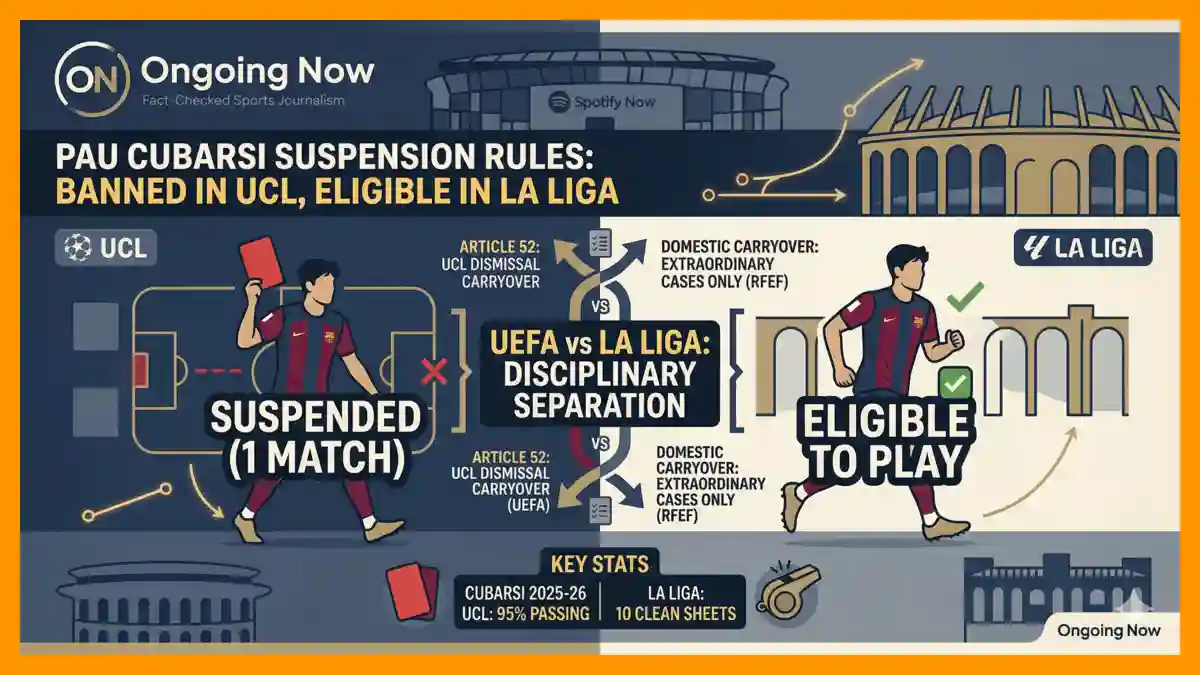
The disciplinary landscape for FC Barcelona has shifted significantly following the dismissal of center-back Pau Cubarsi during the UEFA Champions League quarter-final first leg. On April 8, 2026, Cubarsi received a direct red card in the 2-0 defeat against Atlético Madrid at the Spotify Camp Nou, an incident that has triggered specific Pau Cubarsi suspension rules across different competitions. While the 19-year-old defender faces an automatic one-match ban in European play, his eligibility for domestic fixtures remains intact due to the separation of UEFA vs La Liga red card regulations.
This disciplinary development matters for Barcelona’s season trajectory as they navigate a high-stakes April schedule. The Barcelona Champions League discipline record now includes a critical absence for the return leg at the Riyadh Air Metropolitano. However, the La Liga disciplinary committee decisions typically do not enforce carryover for standard match-related dismissals, meaning the answer to can Cubarsi play today in domestic competition is affirmative. Understanding the Barcelona vs Atletico red card impact requires a look at the suspension carryover rules soccer fans and analysts use to track player availability. Currently, the Pau Cubarsi ban status is limited strictly to the next UEFA-sanctioned fixture.
The Spotify Camp Nou Incident and Red Card Upgrade
The pivotal moment occurred in the first half of the Champions League quarter-final when Cubarsi fouled Giuliano Simeone. Initially, referee Istvan Kovacs issued a yellow card, but a VAR intervention prompted an on-field review. The official subsequently rescinded the booking and issued a straight red card for denying an obvious goal-scoring opportunity (DOGSO).
This decision left Hansi Flick’s side with ten men for over 50 minutes, during which Atlético Madrid secured their 2-0 advantage through goals from Julian Alvarez and Alexander Sorloth. The technical staff’s decision to start Gerard Martin over Ronald Araujo became a point of post-match analysis, especially as Cubarsi’s exit forced an immediate tactical reorganization.
Understanding Pau Cubarsi Suspension Rules
The governing bodies of European and Spanish football maintain distinct disciplinary silos. Under Article 52 of the UEFA Disciplinary Regulations, a red card in a Champions League match results in a suspension from the next match in the same competition. These rules are designed to maintain the integrity of the specific tournament without unfairly penalizing a club in their domestic league.
Conversely, the Royal Spanish Football Federation (RFEF) and La Liga only recognize carryover suspensions in cases of “extraordinary” misconduct, such as physical assault on an official. Because Cubarsi’s foul was a standard professional foul, his Pau Cubarsi ban status does not extend to the Spanish championship. This distinction is vital for Barcelona as they face a congested league schedule while attempting to maintain their position in the top three of La Liga.
Comparing UEFA vs La Liga Red Card Carryover
The suspension carryover rules soccer leagues follow in Europe are often misunderstood by the general public. While a red card in the Supercopa de España can sometimes carry over into La Liga (as seen in past precedents involving high-profile players), European and domestic cycles are almost always isolated.
Key Disciplinary Distinctions
| Regulation Category | UEFA Champions League | La Liga (RFEF) |
| Sanction Body | UEFA Control, Ethics and Disciplinary Body | RFEF Disciplinary Committee |
| Carryover Scope | Restricted to UEFA Club Competitions | Domestic League and Cup (specific cases) |
| Automatic Ban | 1 Match (subject to appeal/extension) | 1 Match (per internal code) |
| Cubarsi Status | Suspended for April 14 Return Leg | Eligible for April 11/12 Fixtures |
Barcelona Champions League Discipline and Squad Depth
The Barcelona vs Atletico red card impact extends beyond a single match. Hansi Flick must now prepare for a second leg without one of his most reliable ball-circulating defenders. Cubarsi, who has averaged a 95% passing completion rate in the 2025–26 Champions League season, provides a unique tactical profile that is difficult to replicate.
In his absence, Flick is expected to reunite Ronald Araujo and Andreas Christensen in the heart of the defense. The availability of Eric Garcia, who has featured both in midfield and defense this season, offers an additional layer of versatility. However, the loss of Cubarsi’s “La Masia” style of play-out-from-the-back could force Barcelona into a more pragmatic, long-ball approach during the return leg in Madrid.
La Liga Disciplinary Committee Decisions and Player Eligibility
As of the latest La Liga disciplinary committee decisions, there are no pending sanctions against Cubarsi for domestic play. He was featured in the squad for the subsequent league match against RCD Espanyol, confirming that the “can Cubarsi play today” query was answered by his inclusion in the starting XI.
Barcelona’s domestic campaign remains the priority for financial stability and automatic qualification for next season’s revamped European formats. With 10 clean sheets in 25 La Liga appearances this season, Cubarsi’s presence is statistically significant for a defense that has conceded 26 goals—a figure the coaching staff aims to reduce in the final quarter of the season.
Measuring the Sporting Impact of Youthful Errors
At 19 years old, Pau Cubarsi is navigating the steep learning curve of elite European football. The red card against Atlético was his first dismissal of the 2025–26 season across 10 Champions League starts. Public sentiment from the Barcelona fanbase has been largely supportive, with many comparing the incident to Ronald Araujo’s sending-off against PSG in the previous season’s knockout stages.
The club’s hierarchy has emphasized a “protective” stance toward the player. “It is a part of his growth,” Flick noted in a post-match press conference. “Pau has been excellent for us all year. We don’t judge him on one split-second decision in a high-pressure match.” This human-centric approach to player management is essential for a squad that relies heavily on teenage talents like Cubarsi, Lamine Yamal, and Gavi.
By the Numbers: Pau Cubarsi’s 2025-26 Season
Total Minutes Played: 2,939 (across all competitions)
UCL Passing Accuracy: 95%
La Liga Tackles Won: 13
Red Cards: 1 (Champions League only)
Yellow Cards: 4 (Total)
Analytical Insight: Why This Result Matters
The suspension of Pau Cubarsi is not merely a personnel issue; it is a tactical dilemma. Barcelona’s system under Flick relies on a high defensive line and quick recovery. Cubarsi’s recovery speed and positioning have often masked gaps left by attacking full-backs. Without him, the Metropolitano return leg will likely see a more cautious Barcelona, potentially sacrificing their high-press identity to protect against Atlético’s counter-attacking threats led by Antoine Griezmann.
The broader sporting impact highlights the razor-thin margins of the Champions League knockout phase. One VAR-reviewed foul can alter a club’s entire defensive strategy for a two-week period, impacting training cycles and domestic rotation. As Barcelona prepares for the second leg, the focus will remain on whether their veteran defenders can fill the void left by the suspended teenager.
Stay sharp with Ongoing Now!
Source and Data Limitations: This report is based on official match data from the UEFA Champions League quarter-final on April 8, 2026, and La Liga domestic records up to April 12, 2026. Statistical data, including passing percentages and tackle counts, is sourced from the Google Sports Data repository and official club performance metrics. Disciplinary rules cited are based on the 2024-2026 UEFA Disciplinary Regulations and the RFEF General Code. Excluded from this report are speculative transfer rumors or unverified locker room reports. Regional variations in disciplinary interpretations are noted where applicable.